

The Shop Slate by My Kitchen Door, and a Green Stick in My Apron
A grocer who chalked "OUT OF" on a store slate for forty years starts writing what she doesn't want to lose. The matcha box a customer brought, read like a delivery invoice.
For forty years, a slate hung behind the register of my store.
It was a real one, black and heavy, in an oak frame my father cut from a shipping crate in 1962.
Across the top, in white chalk, it said OUT OF; underneath, every morning, I wrote what we didn't have that day. Rye bread, AA batteries, the good mozzarella, Edna Kowalski's prune juice.
I closed the store in the spring of 2024, when the building sold. I sold the coolers, gave the shelving to a church pantry and brought home exactly two things.
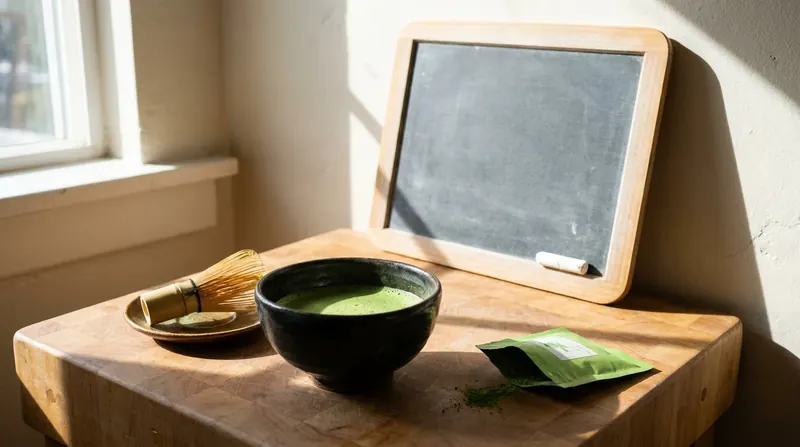 From the Shop Slate · No. 1

One was the brass bell from over the door. The other was the slate.
It leans by my kitchen door now.
And this spring, I wiped it clean, licked my thumb to get the last of the old chalk off the corner, and wrote a new heading across the top.
DON'T LOSE.
This is a column about that slate.
It's also about a woman named Fumiko who bought short-grain rice from me for thirty-one years, a box of green tea sticks from a tea house in Milwaukee, and an old bowl and whisk that came with it.
If you've ever stood in a room and wondered why you walked into it, you'll know most of this already. You just haven't seen anybody keep it on a slate.
Forty Years of Writing Down What Ran Out
Running a corner grocery is not a job, it's a weather system. Deliveries come late, the dairy man comes early, and somebody always needs exactly one onion at five minutes to closing.
My father opened the store at the corner of Linden and Ninth in 1962.
I started stocking shelves at eleven, ran the register at sixteen and took over the lease at twenty-three, when his back gave out.
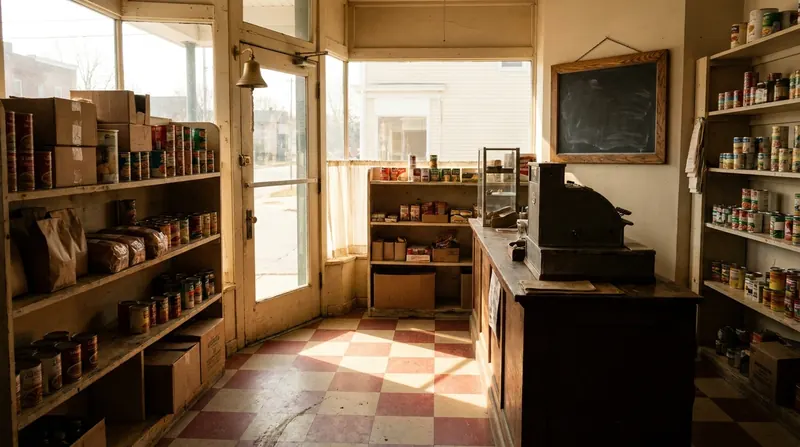
The slate was my father's idea. He said a store that hides what it's out of loses customers twice: once when they find out, and once when they stop trusting the shelves.
So every morning, before I turned the sign, I wrote the truth in chalk.
OUT OF: eggs until Thursday; OUT OF: the 2% milk; OUT OF: patience, on one particular Monday in 1997.
People read that slate the way other people read the newspaper; Walt Delgado from the duplex across the street would come in and look at it.
He'd sigh about the rye and buy a lottery ticket instead.
The slate taught me the lesson that ran the whole business.
You can't restock what you never wrote down.
It sounds simple, and it is. A grocer who keeps her shortages in her head will run out of the same thing three weeks in a row and blame the delivery man.
I wrote down everything. Bread counts, egg counts, who paid on credit until Friday and who was going to need a ride home after the snowstorm.
And for forty years, I carried the names of something like four hundred families in my head. I knew whose boy took the hot peppers and whose mother couldn't have salt.
That's the part I want you to remember, because it matters later. I was the woman on the corner who never forgot a name.
The Spring the Names Started Taking Longer
The first entry I didn't write down was a name. It was a Saturday in March, at the farmers' market where I volunteer at the community table.
A woman stopped at our table and hugged me.
She had bought cold cuts and birthday candles at my counter for twenty years, and I knew her face the way I know my own kitchen.
Her name was right there, on the tip of my tongue. It stayed there through the whole hug, through her question about my sister and through her goodbye.
It came to me an hour later, in the car, at a red light. Bernadette, Bernadette Novak, who took the extra-sharp cheddar.
I said it out loud to nobody, the way you'd yell "Bingo!" in an empty church hall. Then I sat at the green light until the car behind me honked.
The second entry was the keys. They weren't lost, exactly; they moved, the way keys do once you're past sixty.
I'd put them in the blue bowl by the door, where they have lived since 1988. And then I'd find them in the refrigerator door, next to the mustard.
The third entry embarrassed me more than the other two put together. I forgot my grocery list at the grocery store.
You'll want to read that sentence twice, so I'll give you a moment.
A woman who ran a grocery for forty years left her list in the cart corral at the Kroger on Monroe Street.
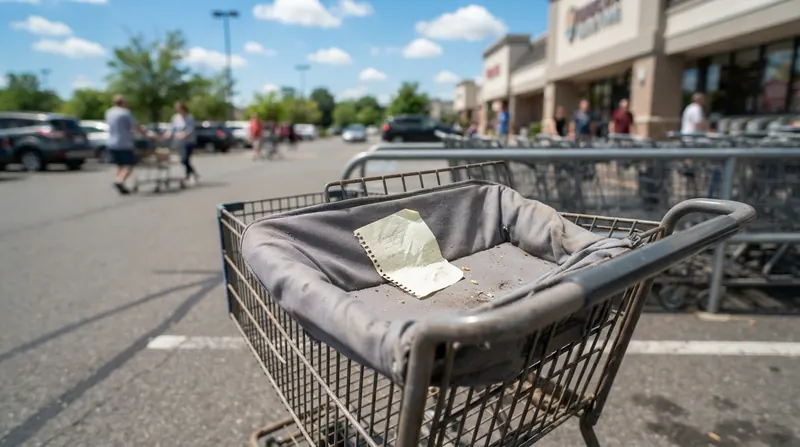
The fourth entry was the one that sent me to the clinic: I was getting the mail, and Mr. Delgado waved from his porch across the street.
He has lived in that duplex for thirty years.
He came to my father's funeral and to my husband's, and he once shoveled the store's sidewalk at five in the morning without being asked.
I waved back. And for a long, cold second, standing at my own mailbox, I could not find the name of the neighbor of thirty years.
It came back before I reached my front door. But I went inside, sat down at the kitchen table and stayed there until the coffee went cold.
What My Clinician Said, and What She Didn't
I made the appointment that afternoon, which tells you how much the mailbox scared me. I'm not a woman who makes appointments the same afternoon.
My clinician is a brisk, kind woman with reading glasses on a beaded chain.
She listened to all four entries, the name, the keys, the list and the neighbor, without once looking at the clock.
Then she asked a lot of questions and ran the routine checks she runs for anybody my age.
She asked how I was sleeping, whether I was eating, whether I saw people and whether I still drove at night.
At the end, she put her pen down. "Nothing on today's checks worries me, Adele," she said.
"Keep your days full. Keep your people close, walk, sleep, and come back in a year, or sooner if anything changes."
I asked her, half joking, whether there was something I should be taking. She smiled and said the honest thing:
"Write things down, and keep showing up for your own life."
I drove home a little relieved and a little insulted, the way you feel when the mechanic says there's nothing wrong with the car.
Because something felt different, even if nothing on her checks said so.
And then I remembered the slate. I'd been writing down what ran out for forty years; I'd just never written down anything of my own.
How a Grocer Keeps Her Own Inventory
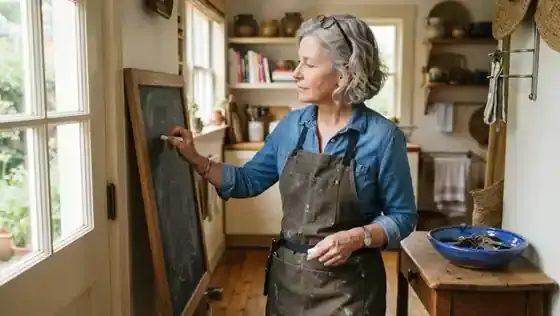
I wiped the old "OUT OF" off with a damp rag. Then I wrote DON'T LOSE across the top in the same block capitals I'd used since the Nixon administration.
Underneath, I made three columns, because a grocer thinks in columns. Names, Places, Today.
Under Names, I wrote the people I see every week whose names I didn't want to fish for: Bernadette Novak, Walt Delgado, Fumiko Sato.
Fumiko doesn't need writing down, but I wrote her anyway.
Under Places, I wrote where things live. "Keys: blue bowl; glasses: the hook by the phone; checkbook: second drawer, not the freezer."
Under Today, I wrote the day's three errands, never more than three. A store runs on a short list;
a long list is just a way to feel busy while the milk goes bad.
My granddaughter Tessa, who is twenty and studying nursing at Ohio State, saw a photo of it and called me the same night. "Grandma," she said, "you've made yourself a shift board."
She's right. It's the board a good hospital floor keeps, and the board a good grocer keeps, and now it was the board a sixty-three-year-old widow kept by her kitchen door.
The first week, the slate worked better than I expected. The keys stayed in the bowl, because I'd written "blue bowl" and I'm a woman who follows her own signs.
The names were harder. Writing a name down doesn't put it on the tip of your tongue; it just tells you where to look when it isn't there.
But I noticed something else in that first week, something the slate couldn't mend with chalk. My mornings were a mess.
The Second Pot of Coffee Nobody Wrote Down
For forty years, my mornings belonged to the store.
I was up at 4:45, I had the first pot of coffee on by five, and by six the bread man was knocking on the back door.
When the store closed, the mornings didn't know what to do with themselves. Neither did I.
So I did what a lot of retired people do.
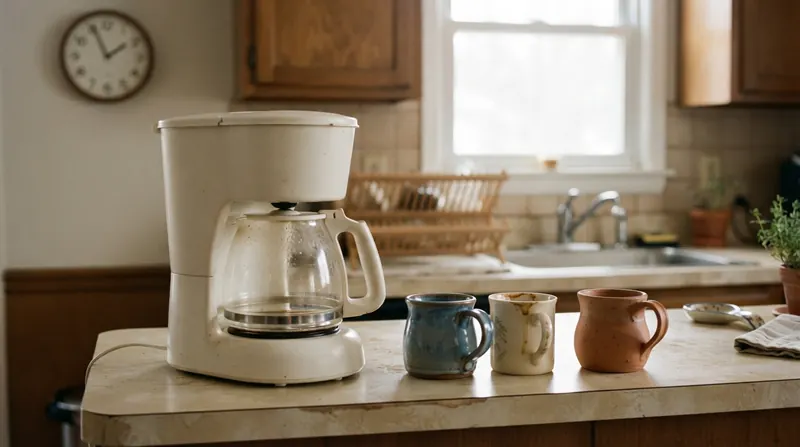
I made the first pot at six out of habit, and then, around ten o'clock, when the house got quiet, I made a second one.
The second pot was the one I never wrote down. It was three big mugs, sometimes four, drunk standing at the counter while I looked at the slate.
By eleven, my hands had a little tremble in them. By noon, I'd be pacing the kitchen like the bread man was late, except there was no bread man anymore.
And by two in the afternoon, I'd crash into the recliner, then lie awake that night wondering why I was staring at the ceiling at midnight.
I'm not blaming the coffee for the names, mind you.
I'm telling you because it was the only part of my morning that had no shape. The slate had columns;
the ten o'clock pot was just a woman refilling a mug because her hands needed a job.
What I Spent Before Fumiko Came Over
I want to be honest about the months before Fumiko's box, because most columns skip this part. A story that only lists what worked is a sales flyer wearing an apron.
So here's the inventory, priced the way I'd price a bad delivery. Every item is real, and so is the money.
Item one: three crossword books from the drugstore, $8.99 each. I finished two, and I liked them, but they were an evening thing, and my trouble lived in the morning.
Item two: a word-game app at $7.99 a month.
It sent me little cartoon trophies, and I cancelled it in the third month because I'd started playing it during the ten o'clock pot, which made the pot longer.
Item three: two packs of sticky notes, $11.49. Within a week, there were yellow squares on the refrigerator, the bathroom mirror, the car dashboard and the television remote.
A sticky note on everything is the same as a sticky note on nothing. The slate works because it's one place;
the notes were forty places, and I stopped reading all of them.
Item four: a key-finder tag for my key ring, $24.99. I'll say this plainly, because a fair column gives credit where it's due.
The key tag worked. It's the only thing on this list I'd buy again, and if the keys are your trouble, you can stop reading here and go buy one.
Item five cost no money at all: I started skipping the Saturday market. I'd decided that if I didn't see Bernadette, I couldn't fumble her name.
That was the worst entry in the whole ledger.
When you skip the people to avoid fumbling their names, you lose the people, not just the names.
Add it up and I'd spent a little over $87 in four months on things that mostly lived in drawers.
Plus four Saturdays I won't get back, and about a hundred and twenty mugs of a second pot I didn't even enjoy.
I wrote that on the back of an old store bag, the brown kraft kind, because I still have a stack of them under the sink. Old habits:
I totaled every sale for forty years on the bag before it went on the register.
The total was higher than I'd guessed in my head, which is exactly why you write totals down. The bag doesn't round in your favor.
The Customer Who Noticed the Slate
Fumiko Sato is seventy-six. She taught piano to half the children on the west side of Toledo for forty-four years, and some of their children too.
She came into my store for the first time in 1993, looking for short-grain rice and nori. I didn't carry either one.
She came back the next week and asked again, politely.
The third week, I had a fifty-pound sack of short-grain rice and a shelf of nori, and she kept coming in every Thursday for thirty-one years.
That's how a corner store works, or how it used to.
A customer asks three times and you make a shelf for her, and then the shelf brings in her neighbor and her neighbor's sister.
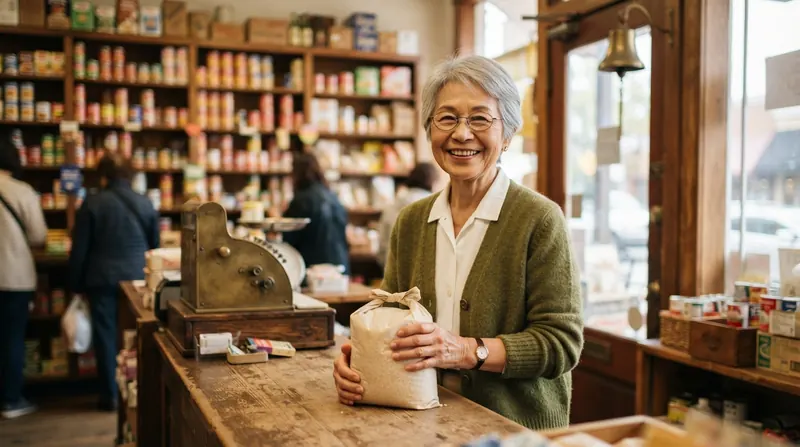
After the store closed, Fumiko and I kept our Thursdays. Now they're at my kitchen table instead of across a counter, and she brings the rice crackers.
On the second Thursday of July, she stood in my kitchen doorway with her coat still on and read the slate from top to bottom.
She reads music the same way, all the way through before she plays a note.
"Your name list has me on it," she said. "I'm flattered and a little worried."
I told her what I'd told my clinician. The name at the market, the keys in the refrigerator, the list in the cart corral and Walt Delgado at the mailbox.
She didn't make a fuss. Piano teachers don't make fusses; they wait for you to finish the phrase.
Then she looked at the coffee maker, at the second pot sitting on the warmer at eleven-fifteen in the morning. "And how many of those do you drink before lunch?" she asked.
I told her the truth: three, sometimes four. She nodded, the way she must have nodded at a student who swore they'd practiced all week.
"Your slate is very good," she said. "But your mornings have no tempo."
What Fumiko Brought the Next Thursday
The next Thursday, Fumiko came in carrying a cloth bundle tied in a knot at the top, the way her mother taught her to wrap things.
She set it on the table next to the rice crackers and untied it slowly.
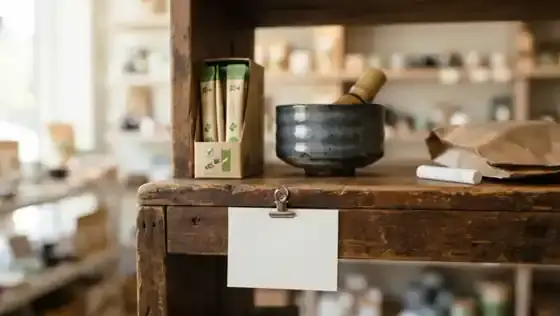
Inside was a wide, dark ceramic bowl, glazed the color of wet slate, with a thumb-sized chip on the foot.
Next to it was a little bamboo whisk with dozens of fine curled tines, like a tiny upside-down broom.
"My mother's chawan," she said. "It came from Fukuoka in a suitcase in 1958, wrapped in a sweater."
Then she took a small box out of her purse.
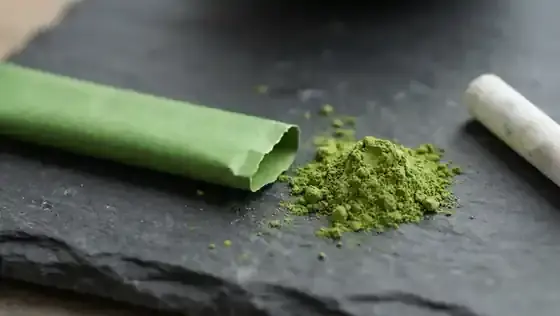
It was a box of seven slim green paper sticks, each one about the size of a sugar packet at a diner, from a tea company called Rishi, out of Milwaukee.
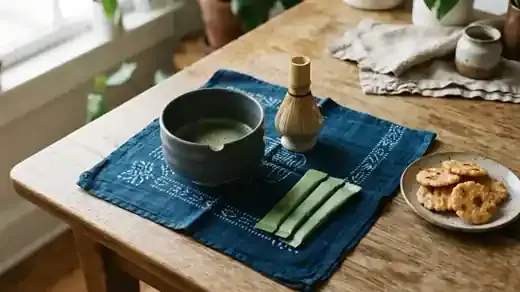
"Matcha," she said. "Green tea, the whole leaf ground to powder; one stick is one cup."
I told her I didn't have the first idea what to do with a bamboo whisk. She laughed, which Fumiko does about twice a year, so I wrote the date down.
"You don't need the whisk," she said, tapping the box. "The box says to pour it in a bottle of water and shake, and that works.
But I think your hands need a job at ten o'clock. So I brought you the slow way too."
I read that slate entry four times before supper. Then I did the grocer thing:
I put the box on the counter and decided to read the invoice before I'd let it anywhere near my bowl.
Did you read the box, or are you still reading the box?
7:51Still reading, back of the box, twice. I'll start Monday at ten.
7:54Good. Wash the whisk in warm water only, no soap, or my mother would haunt you.
7:55No soap. Writing it on the slate right now.
7:57Reading the Box Like a Delivery Slip
Forty years of deliveries teach you to read the slip before you sign it.
The dairy man once tried to sell me "cheese food" at cheese prices, and I've read the back of everything since.
So on Friday morning, with my reading glasses and the first pot of coffee, I read the Rishi box, then the seller's web page, then the back of the bag in the seller's own product photo.
Here's the invoice, line by line.
The company: Rishi Tea & Botanicals, 185 S. 33rd Court, Milwaukee, Wisconsin. They print a phone number, 414-747-4001, with customer service from nine to five Central, Monday through Friday.
A street address and a phone number with a person on the other end.
My checklist for any new supplier at the store was three lines long, and this box ticked two of them before I'd opened it.
The ingredient line: one item. "Organic Japanese green tea."
That's it. No sugar, no flavoring, no "proprietary blend," no list of twenty things I'd need a dictionary for.
The amount: each stick holds 2 grams of matcha. The seller calls it ceremonial first flush matcha, which means the first spring picking, ground to a powder.
The origin: Kagoshima, at the southwest tip of Kyushu Island in Japan.
Fumiko pointed out that it's one prefecture south of where her mother grew up, and she was quietly pleased about it all afternoon.
The certifications: the listing says Certified Organic and Direct Trade. The bag in the seller's photo carries the USDA Organic seal and a kosher mark.
Now the line I read three times.
The seller's own listing marks the caffeine level as "High."
I appreciated that. Most products bury the part you won't like in small type, and this one put it in the badges at the top of the page.
The listing doesn't print a number on the web page. But the back of the bag in the seller's main product photo does, per stick:
caffeine 54 mg, amino acids including L-theanine 65 mg, total polyphenols 170 mg.
That bag in the photo is the 30-stick bag.
The seven-stick box I'm writing about holds the same 2-gram sticks, so I'm reading those numbers as per-stick numbers, the way the bag prints them.
And the seller adds a line I copied onto the slate word for word. "An average cup of coffee contains about 90 – 120 mg / 8oz cup."
I did the arithmetic. My ten o'clock pot was three big mugs, and my big mugs hold closer to twelve ounces than eight.
I'm not going to pretend I measured the caffeine in my own coffee, because I didn't, and coffee varies more than any label.
But even at the seller's low number, three eight-ounce cups is about 270 milligrams; one stick, per its own bag, is 54.
So a stick is not caffeine-free, and nobody should drink it at nine at night.
But one stick at ten o'clock is a lot less than a second pot, and that was the swap Fumiko was really proposing.
She never said "stop drinking coffee." She's seventy-six and she drinks one cup of coffee every morning with the newspaper, black, from the same mug she's had since the Carter years.
What she said was "not a second pot."
That's a different sentence, and as a grocer I know the difference between taking an item off the shelf and changing what goes on it at ten o'clock.
What the Studies Say About Tea, and What They Don't
After the invoice, I went to the public library on Tuesday, because I don't believe anything printed on a box until I've seen the file behind it.
The reference librarian, a patient young man named Marcus, helped me find the papers.
I'm going to tell you what I found the way I'd tell a customer about a new brand. What it says, who paid for it, and how small it was.
Matcha is green tea, and green tea carries two things researchers like to study: caffeine and an amino acid called L-theanine.
The stick's 65 milligrams of amino acids include L-theanine, but the bag doesn't say how much of the 65 is theanine.
The first paper was a small placebo-controlled study of 27 healthy volunteers. They were given 50 milligrams of caffeine with 100 milligrams of L-theanine, all at once, as a single dose. [1]
Compared with a placebo, the caffeine-plus-theanine drink was associated with faster and more accurate performance on an attention-switching task an hour later.
It was also associated with less distraction on a short word task. [1]
50 mg of caffeine with 100 mg of L-theanine was associated with faster and more accurate performance on an attention-switching task 60 minutes after intake, compared with placebo.
One dose, one afternoon, 27 people; the summary doesn't give their ages.
— Owen G.N. et al., Nutritional Neuroscience, 2008, A single-dose study of caffeine with L-theanine in 27 volunteers[1]
Now the fine print, because there's always fine print. It was one dose, on one day, in 27 people, and the summary doesn't even say how old they were.
The authors worked for a company that makes tea. That doesn't make them wrong, but I'd want to know it, so now you know it too.
The second paper came from Japan and is the one closest to my age.
Men and women aged 50 to 69, all with normal scores on a standard mental-status test, were given a single dose of L-theanine or a placebo, double-blind. [2]
The L-theanine group had faster reaction times on an attention task, and more correct answers with fewer missed items on a working-memory task.
That's the researchers' name for a test where you hold a few things in your head and use them. [2]
The fine print again: one dose, and the summary gives neither the dose in milligrams nor how many people took part. Some of the authors were from a tea company.
The third paper lasted four weeks.
Thirty healthy adults, average age 48, took 200 milligrams of L-theanine a day as a supplement, not as tea, and then switched to a placebo, or the other way around. [3]
After the L-theanine weeks, they scored better on tests of verbal fluency and executive function.
Compared with the placebo, the gain in word-finding showed up mainly in the half of the group that started with the lower scores. [3]
Look at that chart the way I looked at it in the library. The caffeine in one stick is close to the caffeine in the first study; the theanine almost certainly isn't.
The stick prints 65 milligrams for all its amino acids put together.
The first study gave 100 milligrams of theanine alone, and the four-week study gave 200, so nobody should look at this box and think they're drinking a study dose.
The fourth paper is the one I'm printing as a contrast, the way I'd show a customer the expensive brand next to the house brand.
It tested a decaffeinated green tea catechin extract, 336 milligrams, in Japanese adults aged 50 to 69. [4]
A single dose was associated with fewer errors on an attention test, and twelve weeks of daily use with faster responses on a working-memory task. [4]
But that was a concentrated extract with the caffeine taken out.
A stick of matcha in a bowl of water is not that extract, and nobody should credit one with the other's study.
Then the government page, which I always read last because it's the least exciting and the most important.
The National Center for Complementary and Integrative Health keeps a plain-English page on green tea. [5]
Green, black and oolong teas all come from the same plant, Camellia sinensis, and green tea contains caffeine.
Liver injury has been reported in some people who used green tea products, primarily concentrated green tea extracts, and green tea may reduce the effectiveness of some medicines.
— National Center for Complementary and Integrative Health, Plain-language page on green tea (updated February 2025), summarized[5]
Read that second line slowly, as I did.
The liver reports came mostly from concentrated extracts, not from a bowl of tea, but if you take anything daily, show the box to your pharmacist before you start.
The same page names a few specific medicines whose effect green tea may weaken.
I won't list them here, because a list in a newspaper column is the wrong place to make that decision; your pharmacist is the right place.
That last line is a note to myself about Gloria, my pharmacist. She has filled my family's orders since she was a cashier at the Rite Aid on Sylvania Avenue.
So here's my honest summary of the file, the way I'd write it on the slate.
Small studies, mostly single doses, mostly paid for by tea companies, none of them on this stick, and a sensible government page that says the extracts, not the cups, are where the caution lives.
That isn't a reason to buy a box of tea.
But it isn't a reason to be afraid of one either, and it told me exactly how big a promise I could make myself, which was none.
A Cup of Tea, Not a Promise in a Box
Before I tell you how the mornings went, let me tell you plainly what this is and what it isn't. I'd want a supplier to do the same for me.
It's tea. Green tea leaves, grown in Japan, shaded, steamed, dried and ground into a powder fine enough to dust a cake.
With ordinary green tea, you steep the leaves and throw them away.
With matcha, you whisk or shake the powder into water and drink the whole leaf, which is why it's bright green and why it carries more than a tea bag does.
It isn't a supplement.
There's no "serving facts" panel full of vitamins, nothing to swallow with a glass of water and nothing on the box that claims to do anything to your head.
It isn't caffeine-light. The seller marks it "High," and I believe them, which is why it belongs to the morning and never to the evening.
And it isn't the slate. Nothing in a green stick puts Bernadette's name on the tip of your tongue; the slate does what the slate does, and the bowl does something else.
What the bowl does is give the ten o'clock hour a shape. That's the whole of it, and I've come to think it's not a small thing.
The Fast Way on the Box, and the Slow Way in the Bowl
The seller's directions are three steps long, and I'll give them to you exactly. Fill a 16.9-ounce reusable water bottle with cold water, leaving a little room at the top.
Add one stick. Shake vigorously, and drink.
The listing says it plainly: "no sifting or whisking necessary." That's the version for the car, the porch, the walk to the mailbox or the Saturday market.
I do it that way on market days, and it works exactly as the box says.
A stick fits in the front pocket of my old shop apron, next to the chalk, and a water bottle fits in the canvas bag.
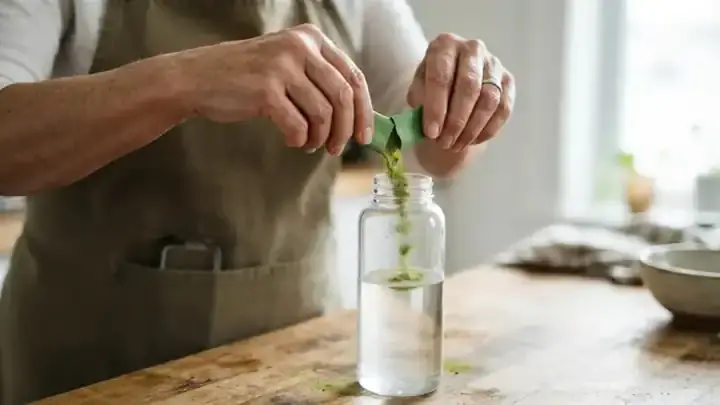
But at home, at ten o'clock, I do it Fumiko's mother's way. Not because the box asks for it, but because my hands asked for it.
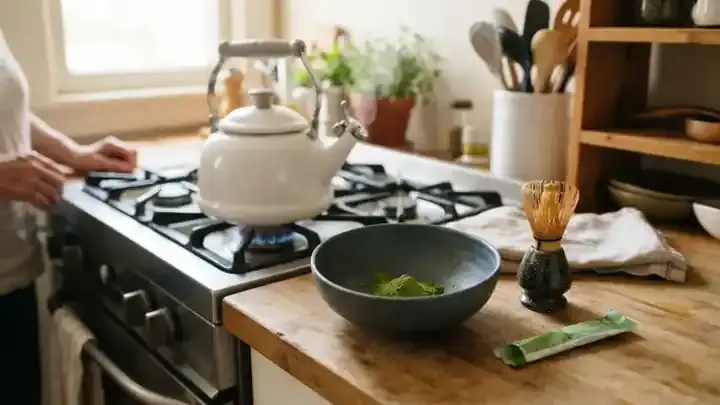
10:00: I take a stick from the box and tear it at the notch; the powder goes into the chawan.
It sits there, a small bright green heap in the bottom of a bowl the color of slate.
I pour in a splash of water from the kettle, after the kettle has rested a minute off the boil.
Fumiko says boiling water makes it taste like a lawn, and she's right.
Then I whisk. Fumiko showed me how, standing behind me with her hands over mine, the way she must have shown a thousand children where middle C was.
You don't stir it in circles like pancake batter. You flick the whisk quickly back and forth in a zigzag, from the wrist, until a fine pale foam covers the top.
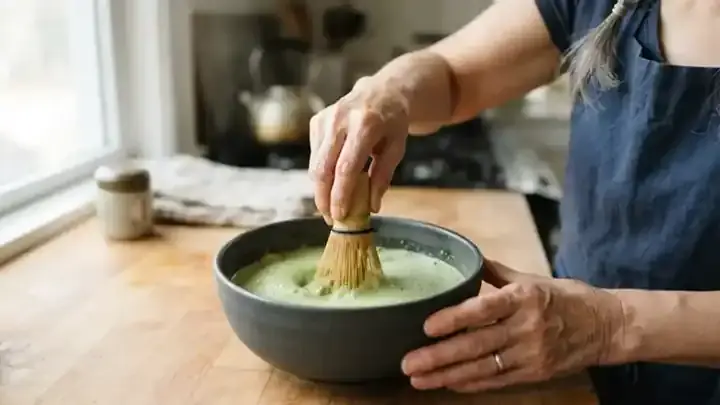
It takes about a minute of whisking, and another minute to drink it. Two minutes, start to finish, in a bowl that came from Fukuoka in a suitcase in 1958.
The taste surprised me.
I expected grass, and instead it was rich and a little sweet, like fresh spinach and toasted rice, with a slight bitterness at the end that disappears if you add a little more water.
I'll be honest: the first three bowls were too strong.
I used too little water and whisked too slowly, and Fumiko took one look at my lumpy green paste and said, "That's not tea, that's wallpaper paste."
By the fourth morning, I'd found my ratio. A stick, about four ounces of hot water for whisking, and then a little more to top it up if it's strong.
On hot days, I do what one of the reviewers on the seller's page does.
I shake it with ice water for a lighter drink, and I'll show you her review further down.
The whisk is the part I didn't expect to matter.
For two minutes, my right hand has a job and my eyes have a bowl to watch, and the house that used to feel empty at ten o'clock has a small sound in it.
I'm not going to dress that up as science. It's the same reason I liked unpacking the bread delivery: the hands keep busy, and the head goes quiet and tidy behind them.
Grandma did you just send me a picture of green foam
10:04That's my ten o'clock, in Fumiko's mother's bowl. Look at that foam.
10:06It looks like a tiny pond. I'm proud of you, and also is the coffee pot off?
10:07Off since six-thirty. Writing it on the slate so you'll believe me.
10:09What the Bowl Replaced, and What It Didn't
Let me be exact about this, because a grocer's word is only as good as her scale. The stick replaced my second pot; it did not replace my first.
I still make one pot at six, and I still drink two mugs of it with the radio and the obituaries, the way I have since 1983.
Fumiko would never ask me to give that up, and I wouldn't listen if she did.
What changed was ten o'clock. Where there used to be three or four mugs drunk standing up, there's now one bowl drunk sitting down.
By the seller's own figures, that's about 54 milligrams instead of a few hundred. I didn't measure anything, but my hands noticed before I did.
The tremble at eleven went away in the first week.
The noon pacing went away in the second, and by the end of the month I'd stopped crashing into the recliner at two.
I'll say this carefully. That's what happens when you drink less coffee, and I'd have gotten the same result if I'd simply stopped the second pot and stared at the wall.
But I hadn't stopped it, in two years of trying.
The second pot had a job, which was keeping my hands busy at ten, and nothing had replaced that job until a bamboo whisk did.
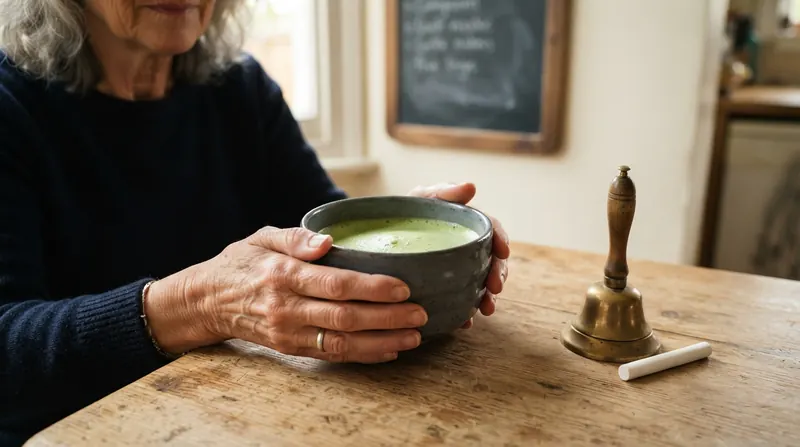
And here's the part I didn't expect. Two minutes of sitting with a bowl turned out to be the best two minutes of the day for looking at the slate.
I'd sit down with the chawan, look up at DON'T LOSE, and read the Names column the way Fumiko reads a page of music.
Bernadette Novak, Walt Delgado, Fumiko Sato, and by August, eleven more.
That's not the tea doing anything to my head. That's a woman reading the same list every morning at the same time, sitting still, with nothing else in her hands.
Ten o'clock had become the hour I studied the slate.
And a grocer who studies her inventory every morning doesn't run out of eggs.
What Other Customers Say on the Seller's Page
At the store, I trusted one kind of review above all the others: the customer who came back.
A woman who buys the same bread three Saturdays in a row has told you more than any sign in the window.
The seller's page shows 23 reviews, averaging 5.0 stars. Only five of them display their text on the page, and I've copied those five exactly as written, typos included.
The portraits next to them are illustrative; the seller doesn't publish photos or hometowns. The words are theirs, word for word.

Easy to use, delicious. I especially like shaking with ice water for a lighter beverage.
Susan is the reviewer I mentioned, the one with the ice water. I tried it on the hottest day of August, after the market, and she's right:
it's lighter, and it went down like a glass of lemonade.

So glad you have started making these sticks again! During the past 2 years I tried so many other brands and even tried to make my own. Nothing beats these sticks.
Elwynne's review tells me something a grocer always wants to know about a product. It went away for a while, and somebody missed it enough to say so when it came back.
Customers don't write "so glad you're making these again" about things they were lukewarm on. They write it about the bread they drove across town for.

I bought this for my granddaughter ... she makes a huge mess when she wants a cup of Matcha. It tastes great and the mess is less.
Kathleen made me laugh out loud, because Tessa is the same.
The one time she made matcha in my kitchen from a loose tin, it looked like a lawn mower had gone through the counter.
The sticks are tidier than a tin and a spoon. I'll give you that one without reservation, because it's the reason they fit in an apron pocket.

I belong to a Japanese church and tea ceremonies are a part of our practice. I have tasted many different types of matcha over my 30-year involvement, and this matcha is the tastiest. The aroma is so delicious and the taste is something that I look forward to partaking in every morning. No other matcha, in my experience, can hold a candle to it.
I read Liseli's review to Fumiko over the phone. She was quiet for a moment and then said, "Thirty years of ceremonies; she would know."
From Fumiko, that's a standing ovation. "Something that I look forward to partaking in every morning" is, word for word, what the ten o'clock bowl became for me.

Alwasy love Rishi Tea!
Yes, "Alwasy." I left it exactly as she typed it, because a review copied with the spelling fixed is a review somebody has handled.
Now the fair part.
Five reviews with text, out of 23, is a small window, and five stars from a small window tells you people who wrote in liked it, not that everybody will.
None of the five says anything about names, keys or grocery lists, and I'd distrust them if they did.
They talk about taste, convenience and less mess, which is what a box of tea can honestly offer.
Eight Weeks of Chalk, Good Mornings and Bad Ones
I started on Monday, July 20, the week after Fumiko's bundle. I'd like to say I started out of hope, but mostly I started because Fumiko was going to ask on Thursday.
I kept the slate the way I'd always kept it. And I added a small tally in the bottom corner:
one line for every mug of coffee after nine o'clock, and a circle for every bowl.
The tally in the corner of the slate, July to September
- Week 1Bowl at 10:00 five days of seven. Three bowls tasted like wallpaper paste. Coffee after nine: 6 mugs all week, down from about 20. Hands steadier by Friday.
- Week 2Bitter, lumpy, and I nearly gave the box back. Made a second pot Wednesday out of pure stubbornness. Fumiko re-taught the zigzag on Thursday.
- Week 3Found my ratio. Shook one with ice water after the market, like Susan. Back at the community table two Saturdays running.
- Week 4The bad week: Tessa's car broke down, I drove to Columbus, no bowl for three days and coffee from gas stations. Wrote "away from the slate" and moved on.
- Week 6Bowl seven days of seven. Coffee after nine: 1 mug all week. Read the Names column every morning; fourteen names on it now.
- Week 7Ordered my second box. Gave two sticks to Walt Delgado, who said it tasted like "a very serious salad."
- Week 8Back to the clinic for my flu shot, with the slate photographed on my phone.
I want to slow down on week two, because it's the week most people quit anything.
I made a second pot on Wednesday of that week, the whole pot, and drank it standing at the counter like a woman making a point.
The point was lost on the coffee maker.
On Thursday, Fumiko stood behind me again and re-taught the zigzag, and she didn't say one word about the pot, which was worse than if she had.
What kept me going was the same thing that kept me open through two recessions and a road-construction summer. You don't judge a store by its second week.
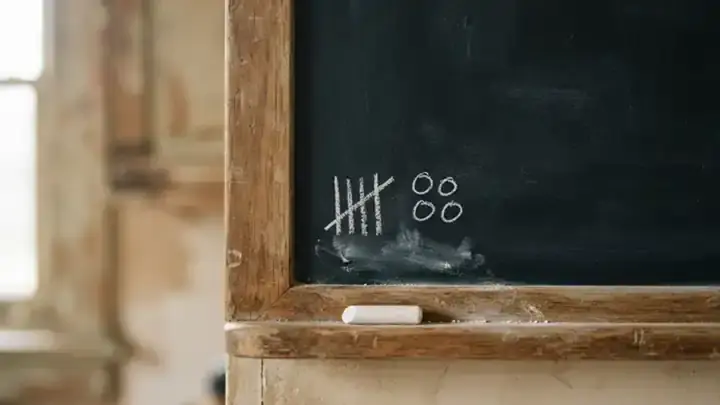
Week three is the entry I'd circle in red if I were grading the slate. I went back to the Saturday market, two weeks in a row.
I'd read the Names column at ten o'clock on Friday with my bowl, so on Saturday, when Bernadette Novak came to the table, her name was where I'd left it.
That's the slate, not the tea, and I'm putting it in bold so nobody mixes them up.
What the tea did, if it did anything I can honestly name, was put me in my chair at ten with my eyes on that column.
Before the bowl, ten o'clock was a woman pacing with a mug.
Week four was the bad week, and I'm printing it because a slate that skips the bad week is a sign in a window, not an inventory.
Tessa's car died on the interstate outside Columbus, and I drove down to help.
Three days, no bowl, no slate, and coffee from gas stations in paper cups. I wrote "away from the slate" on the corner when I got home and didn't scold myself once.
Week six is the one Fumiko asked to see on Thursday.
The bowl had happened seven days out of seven, and my tally of coffee after nine had gone from about twenty mugs a week in July to one.
One mug, and that one was at Bernadette's, to be polite. Fumiko looked at the corner of the slate for a long time and then said, "That's a good tempo."
Morning, Adele. Your order is ready whenever you're by.
9:12Thank you. I'll come after the market, and I'm bringing a box of tea to show you.
9:20Bring it with your list and we'll look at it together at the counter.
9:21Box and list, in the apron pocket. See you around noon.
9:23I did show Gloria the box, with my list of everything I take daily.
She read the back carefully, the way I'd read a delivery slip, and we talked about it at the counter for a few minutes.
I won't print what she said about my own list, because that conversation belongs to me and my pharmacist.
But I'll tell you the shape of it: bring your list, bring the box, and ask before you start, not after.
Week seven, I ordered my second box from Milwaukee.
It came in a small cardboard mailer, and I paid the shipping, because seven sticks don't reach the seller's threshold for the no-charge shipping.
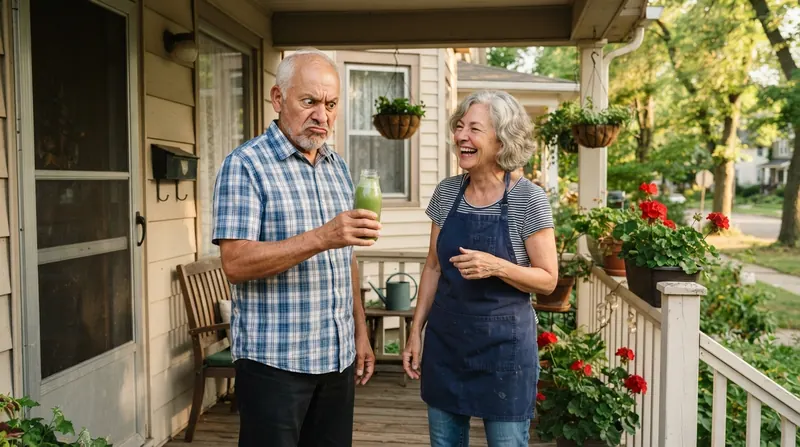
I gave two sticks to Walt Delgado across the street, on his porch, the same porch I'd stared at from my mailbox in the spring.
He made a face like a man eating his vegetables and called it "a very serious salad."
Then he asked if he could keep the second stick. I'm counting that as a five-star review.
Week eight, I went back to the clinic for my flu shot and brought a photo of the slate on my phone.
My clinician looked at it for a long time, longer than she looked at the flu-shot form.
"That's a good system," she said, which from her is a parade.
She asked about the tally in the corner, and I told her the whole story of the second pot and the bowl.
She didn't tell me the tea was doing anything, and I didn't ask her to. She said, "Less coffee at ten, more people on Saturday, a list you read every morning:
keep all three."
One Ordinary Day, Hour by Hour
People ask me what a day looks like now, so here's an ordinary Tuesday in October, copied off the slate. Nothing much happens in it, which is the point.
6:00 a.m. — the first pot, two mugs, the radio and the obituaries; I read the obituaries the way I used to read the delivery schedule.
Lately I'm glad to find nobody I know.
7:30 a.m. — a walk to the end of Linden and back, past the corner where the store used to be; it's a phone repair shop now.
The young man who runs it waves at me every morning.
10:00 a.m. — the bowl: tear, pour, a splash of water off the boil, zigzag for a minute. Then I sit down with it facing the slate.
I read the Names column top to bottom. Then Places, then Today, and I add or wipe one thing with my thumb.
10:05 a.m. — I rinse the whisk in warm water, no soap, and set it on its little ceramic stand to dry; Fumiko's mother would be pleased. Fumiko checks.
Noon: lunch, the mail, and a wave across the street to Walt, by name, every single time.
I don't need the slate for his name anymore, but I leave it up there out of respect.
Afternoon: on Tuesdays it's the library, on Wednesdays my sister's, on Thursdays Fumiko and the rice crackers.
On Saturday it's the market table, a water bottle in my canvas bag and a stick in my apron pocket.
Evening: supper, the news, and one last look at the slate before bed. I wipe the Today column clean and write tomorrow's three errands, never more than three.
That's it. One bowl in the morning, one slate by the door, one walk, and people on most days of the week.
The box asks two minutes and seven sticks a week, and the slate asks one look every morning.
Neither has asked me for anything I couldn't keep doing in December, which is why I trust them both.
What Readers Wrote When This Ran as a Short Column
A shorter version of this column ran in a neighborhood newsletter in September. The comments were better than the column, which in my experience is how it always goes.
The comments below are illustrative, retold from reader notes with names shortened. Replies sit indented under the comment they answer, and they're here because they ask what you're probably asking.
Dolores's comment is the one I've thought about most. "Told everyone it was my hip."
I did the same with the market.
We invent a respectable reason for staying home, because the real reason feels like a confession, and at our age a confession can feel like a verdict.
And Tom's comment is the reason I'll print the arithmetic further down. A grocer who won't tell you the price per unit is hoping you won't do the division.
Fumiko and I, Recorded for the Market Newsletter
In September, the market newsletter asked whether Fumiko and I would let them record one of our Thursday conversations for their "Neighbors" page. Fumiko said yes before I could say no.
Here's the transcript, trimmed only for the parts where the kettle whistled and we both got up at once.
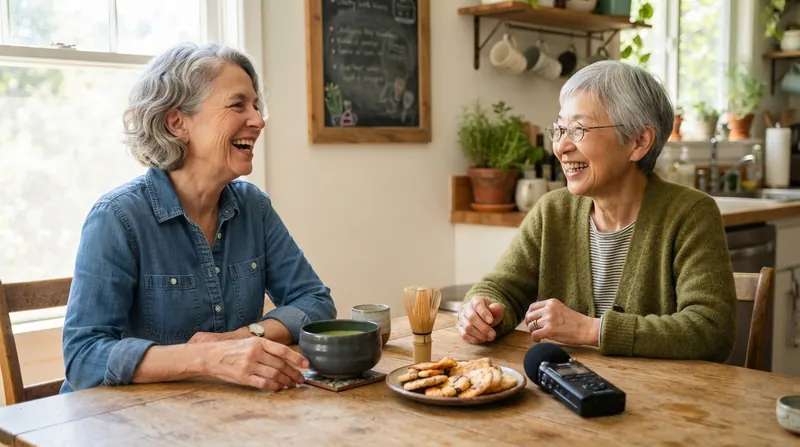
Neighbors · The Thursday Tapes, Episode 7
A Grocer, a Piano Teacher, One Bowl and a Slate
Adele
host
Fumiko, the newsletter wants to know why a piano teacher brought a bamboo whisk to a grocer's kitchen.
 Fumiko
guest
Because your slate was beautiful and your mornings had no tempo; every student I ever had who played too fast was nervous, not talented. You were drinking coffee like a nervous student plays scales.
Adele
host
People write to ask whether it helps with names. What do you tell them?
Fumiko
guest
I tell them the slate helps with names, because you read it every morning, and the tea helped you sit down and read it. Seeing people every Saturday helps most of all, so don't give the bowl credit for the slate's work.
Adele
host
Last question. What would you say to somebody standing at their own mailbox right now, fishing for a neighbor's name?
Fumiko
guest
Go inside, find something to write on, and write the name down while you still have it; then tell your clinician what happened. And if your mornings have no tempo, find two minutes that belong to you.
Fumiko listened to the recording afterward and asked for one correction. She wanted it on the record that she has never once played scales nervously, which her sister in Seattle disputes.
I've gone back to that last line of hers more than any other. "Find two minutes that belong to you."
If those two minutes turn out to be a bowl of green tea, here is everything I'd want to know before I ordered, in one place, the way I used to put the price on the shelf before the product.
Seven single-serve sticks · one ingredient · read the caffeine line before ordering
The Satisfaction Policy, Read Like a Supplier Contract
I won't call the seller's policy a refund promise, because the page doesn't use that word and I won't put them in its mouth. Here is what it actually says, in order.
The window: if you're not satisfied with a product, or you feel its quality is less than expected, you contact Rishi's customer service within 45 days of your purchase date.
Who it covers: original end-user purchasers in the United States, buying from Rishi or one of its authorized sellers.
If you bought the box at a third-party store, the seller asks you to start with that store's return policy.
How they decide: case by case. They may ask for proof of purchase or photos of the product or packaging, and they say they can change or end the policy without notice.
Here's what I'd actually do, as a woman who spent forty years telling customers to try the small size first. Start with the box of seven.
Seven sticks is one week of bowls, or two weeks if you only do market days.
That's enough to find out whether you're a Liseli, who looks forward to it every morning, or a Walt, who calls it a very serious salad.
If you're a Walt, you're out about the price of a sandwich and a coffee. You don't need a policy at all; you need a neighbor who likes salad.
The company prints a street address in Milwaukee and a phone number with a person behind it, 414-747-4001, weekdays nine to five Central.
A street address, a phone number and a policy written down where anyone can read it: my supplier checklist, all three lines.
Five Letters That Came to the Kitchen Table
After the short column ran, I got more letters than I've had since the week the store closed. I've answered the five that asked what most of the others asked.
The letters behind these questions are illustrative composites, retold from reader notes. The answers are mine, the same ones I'd give you across the counter.
Short answers to the questions Fumiko gets on Thursdays
How do you make it?
The seller's way: one stick in a 16.9 oz bottle of cold water, shake hard, drink. My way at home: one stick in a wide bowl, a splash of water from a kettle that has rested a minute off the boil, a quick zigzag with a bamboo whisk until it foams, then top it up to taste.
Do I need a bowl and a whisk?
No, the listing says plainly there's no sifting or whisking necessary. I use them because my hands like the job; a water bottle works exactly as the box says.
How much caffeine is in it?
The back of the bag in the seller's product photo says 54 mg per stick, and the listing marks the caffeine level "High." The seller puts an average 8 oz coffee at about 90 to 120 mg, so it's a morning drink, not an evening one.
Will it help me remember names?
Nobody honest can promise that, and I won't; the small studies on tea compounds used single doses or concentrated amounts, and none of them tested this stick. What helped me with names was a slate I read every morning and going back to the people, and the bowl gave me two quiet minutes to read it.
Is there anything I should check first?
Yes: if you take anything daily, show the box to your pharmacist before you start, because the federal green tea page notes that green tea may reduce the effectiveness of some medicines. Also keep it in the morning if caffeine keeps you up, and ask your clinician if you're unsure.
Who This Box Is For, and Who Should Skip It
I wouldn't close out a delivery without telling you which customers I'd sell it to, so here's my list. Fair notice: half of it tells some of you not to buy.
It probably makes sense to look at it if:
- Your mornings have an hour with no shape, a second pot, a pacing hour, a ten o'clock you'd like back
- You want a two-minute ritual with your hands busy, not something to swallow with water
- You like green, toasty, slightly bitter flavors, or you're willing to find your ratio over a few mornings
- You'd rather read one ingredient than a list you need a dictionary for
- You'll keep a slate, a notebook or a list, and read it every morning while the bowl cools
It probably isn't for you if:
- You want a promise about names or keys; nobody honest can give you one, and the box doesn't try
- Caffeine keeps you up or makes your heart race; at 54 mg a stick, it's not an evening drink
- You take something daily and haven't shown the box to your pharmacist yet
- You want the cheapest possible cup; a box of tea bags costs a fraction of $3.64 a cup
- You don't like green tea; three bowls will tell you, and Walt would agree
That first line on the second list matters most.
This is a bowl of tea, not a plan; the plan is the slate, the people and whatever you and your clinician write down together.
What a Bowl Costs Against What I Already Spent
Now the money, because Tom from the comments made me promise I'd put it in black and white. The box is $25.50 for seven sticks.
That's about $3.64 a stick, before the $8 shipping, which spread over one box adds about $1.14 a stick. Call it $4.78 a bowl if you buy one box at a time.
For comparison, a matcha latte at the coffee stand by the market runs about six dollars, and it comes with a cup lid and a line.
A box of ordinary green tea bags costs much less per cup than either, and I'll say that plainly because Tom would.
I'm not saying the $87 was wasted because the bowl costs less per day.
I'm saying the $87 was aimed at my evenings, my phone and my refrigerator door, and the $3.64 is aimed at ten o'clock.
The key tag, I'd buy again. The rest went into a drawer, and the bowl went onto the counter, where it's been every morning since July.
✓ One ingredient, printed plainly. Organic Japanese green tea, from Kagoshima, and nothing else on the line.
✓ A caffeine number you can read. 54 mg per stick on the back of the seller's bag, and the listing marks it "High" in the badges, not in small type.
✓ A Milwaukee phone line and street address. 414-747-4001, weekdays nine to five Central, and a written 45-day satisfaction policy.
✗ No study on this stick. The research file is small, mostly single doses and mostly about tea compounds in measured amounts, not about a bowl of matcha.
✗ Not cheap for tea. About $3.64 a stick, plus $8 shipping on a single box.
Where the Link Goes, and What's Behind It
I won't pretend a link at the bottom of a neighborhood column is anything but a door to the seller's shop. Matcha & Slate doesn't keep inventory; we keep slates.
But if you walk through that door, you'll know exactly what's on the other side.
Seven green sticks, one ingredient, a caffeine number on the bag, a written policy and a Milwaukee phone line.
Seven single-serve sticks · organic Japanese green tea · a morning drink, not an evening one
One more thing, and then I'll let you get to your own ten o'clock. The slate is still by my kitchen door, leaning where it's leaned since the spring.
This morning's line under TODAY reads: "Oct 26. Bowl 10:00.
Coffee after nine: 0; market table. Walt's birthday, bring the card."
Walt's birthday.
I wrote it on the slate a week ago, and I'll read it again tomorrow at ten, with a bowl in my hands, before I walk the card across the street.
In the spring, I couldn't find his name at my own mailbox.
This fall, his birthday has been sitting in chalk by my kitchen door for a week, waiting for me to read it.
That's the slate's doing, and the people's, and a little bit the doing of two quiet minutes at ten o'clock.
I won't give the bowl more credit than that, and Fumiko wouldn't let me if I tried.
If your own mornings have no tempo, start with something to write on. Find one place for the names, and one place for the keys.
Then, if you'd like company while you read it, put the kettle on, or shake a stick into a bottle of water. Two minutes is plenty.
P.S. Fumiko's mother's bowl lives on my counter now, between the brass shop bell and the box of chalk, and if you have a Fumiko in your life, thank her; if you are the Fumiko, bring the bowl anyway.
P.P.S. Remember the order my clinician gave me, less coffee at ten, more people on Saturday, a list you read every morning: the bowl is the smallest of the three, and it's the only one that comes in a box.
The full ingredient guide, with a note on what is in each stick and on reading the advertising around this box, is linked at the foot of this page.
First, the people: Adele Brennan is a pen name. Fumiko, Tessa, Walt and the regulars at the corner are composites, the way neighborhood columns have always been written.
Everything about the tea itself comes from the seller's own pages, read in October 2026. That means its label, its price, its directions, its reviews and its satisfaction policy.